
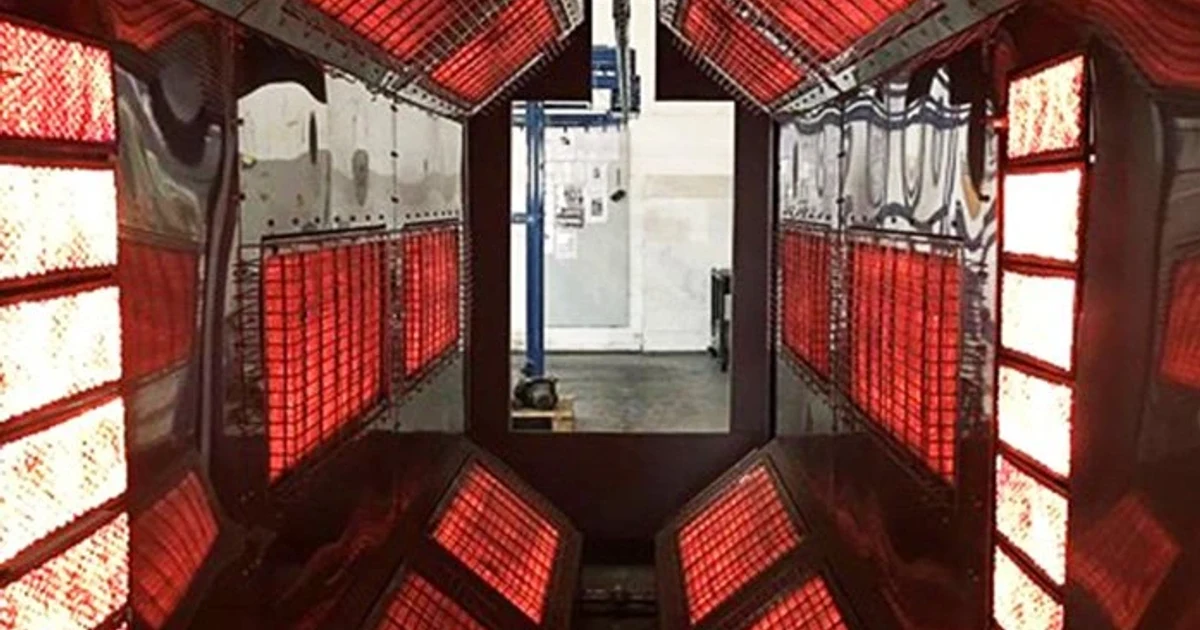
The right decision depends on the material, the coating, the time available, the space in line, operational safety, and the final result desired. Therefore, within the Infragas range, technologies such as INFRACAT, BOOSTERCAT, and RHT meet different thermal needs.
Infragas designs and manufactures catalytic infrared gas panels and high-temperature infrared systems for surface heat treatments. Their solutions are used in applications such as drying water-based or solvent-based paints, melting and polymerising powder coatings, drying inks on paper and glass, processes in MDF and HDF, oil & gas, coil coating, and other industrial heat treatments.
Start from the process, not the product
The choice between INFRACAT, BOOSTERCAT, and RHT should always start from the process. Not all heat treatments require the same intensity of heat or the same temperature profile. In some cases, controlled surface heating without an open flame is required. In others, a higher power density is needed. In more demanding applications, the process may require very high temperatures or rapid curing times.
For this reason, there is no single "better" technology in absolute terms. There is the most suitable technology for a specific material, a specific line speed, and a specific industrial outcome.
INFRACAT: catalytic panels for controlled heat
INFRACAT is Infragas's catalytic infrared panel technology. Its name derives from the combination of infrared energy and catalytic technology. These panels operate with natural gas or propane and generate heat through a catalytic process, emitting infrared energy towards the product surface.
INFRACAT panels can modulate the surface temperature in an approximate range of 180 °C to 550 °C. This makes them suitable for treatments where heat control is more important than maximum thermal intensity.
INFRACAT can be useful in industrial ovens, drying lines, preheating, surface treatments, and applications where direct, stable, and repeatable heat transfer is needed. It is also interesting when working with sensitive products or coatings, where excessive or poorly distributed temperature could cause defects.
When to choose INFRACAT
INFRACAT is a logical choice when the process requires controlled catalytic infrared heating. It may be suitable for drying paints, evaporating water or solvents, surface preparation, heating coatings, and other treatments where energy must primarily act on the surface.
It can also fit well into modular oven designs because the panels can be arranged according to the product geometry, transport speed, and required thermal profile. In this case, the advantage is not just in heating, but in directed heating.
BOOSTERCAT: when higher power is needed
BOOSTERCAT also belongs to the family of catalytic infrared panels from Infragas, but it responds to processes that require greater thermal intensity. Its surface temperature can be modulated approximately between 180 °C and 650 °C, with powers that, depending on the panel size, can vary from 6 kW to 25 kW.
The main difference from a standard catalytic panel lies in its enhanced configuration, which may include integrated ventilation or forced air behind the heater. This allows for increased treatment intensity and improved energy transfer in more demanding processes.
BOOSTERCAT should not be understood simply as a "hotter" version. Its function is to provide greater infrared power density when exposure time is limited, when the line operates at higher speeds, or when the oven needs to maintain compact dimensions.
When to choose BOOSTERCAT
BOOSTERCAT may be the right choice when INFRACAT does not provide enough intensity to meet cycle times or thermal requirements of the process. It is particularly interesting in treatments where drying, preheating, or phases related to coatings and powder paints need to be accelerated.
It can also be useful when wanting to reduce the length of a thermal section without losing effectiveness. In industrial lines where space is limited, a higher power density can help design more compact ovens or treatment stations.
The choice of BOOSTERCAT should be based on specific variables: line speed, material, thickness, type of coating, target temperature, and expected quality.
RHT: high temperature through air-gas infrared
RHT, short for Radiant High Temperature, is a technology distinct from INFRACAT and BOOSTERCAT. It is not a catalytic panel but a pre-mixed air-gas infrared system designed for high-temperature processes.
Infragas's RHT systems can reach a surface temperature of up to 950 °C. Heat is generated through the combustion of natural gas or propane and is transmitted via short-wave infrared rays. The energy emitted by the radiant surface is absorbed quickly and evenly by the exposed materials.
RHT is designed for processes that require high temperatures or rapid curing times, such as preheating metal parts, moulds, powder melting, and other demanding industrial applications.
When to choose RHT
RHT should be considered when the process needs a thermal intensity greater than that offered by catalytic panels. It is suitable for applications where response speed, high temperature, and direct energy transfer are decisive factors.
Unlike INFRACAT and BOOSTERCAT, RHT operates with a high-temperature logic based on pre-mixed air-gas combustion. Each burner is equipped with a control and premix system for a calibrated mixture of air and gas. Additionally, RHT can operate with power modulation in an approximate range of 100% to 50%.
Infragas manufactures standing-alone versions, where each unit is independent, and remote-controlled versions, prepared for connection to a main PLC.
A practical comparison between the three technologies
In simple terms, INFRACAT is suitable when control, modularity, and catalytic infrared heating for surface treatments are sought. BOOSTERCAT comes into play when more power is needed within the same catalytic logic. RHT is the solution for high-temperature processes, where a more intense and rapid thermal transfer is required.
The comparison should consider three main questions: what temperature the process needs, how much time the product has to receive the treatment, and what level of thermal intensity the material can accept without compromising quality.
A technical choice for every thermal need
Choosing between INFRACAT, BOOSTERCAT, and RHT means adapting the heating technology to the actual process. INFRACAT responds to controlled catalytic treatments, BOOSTERCAT offers greater power for more demanding cycles, and RHT covers high-temperature applications with pre-mixed air-gas systems. In the Infragas range, these three solutions allow for drying, preheating, curing, powder melting, and surface heat treatments from a technical logic: using the right energy, at the right point, with the level of control that industrial production requires.

Trending on the web

You may also like