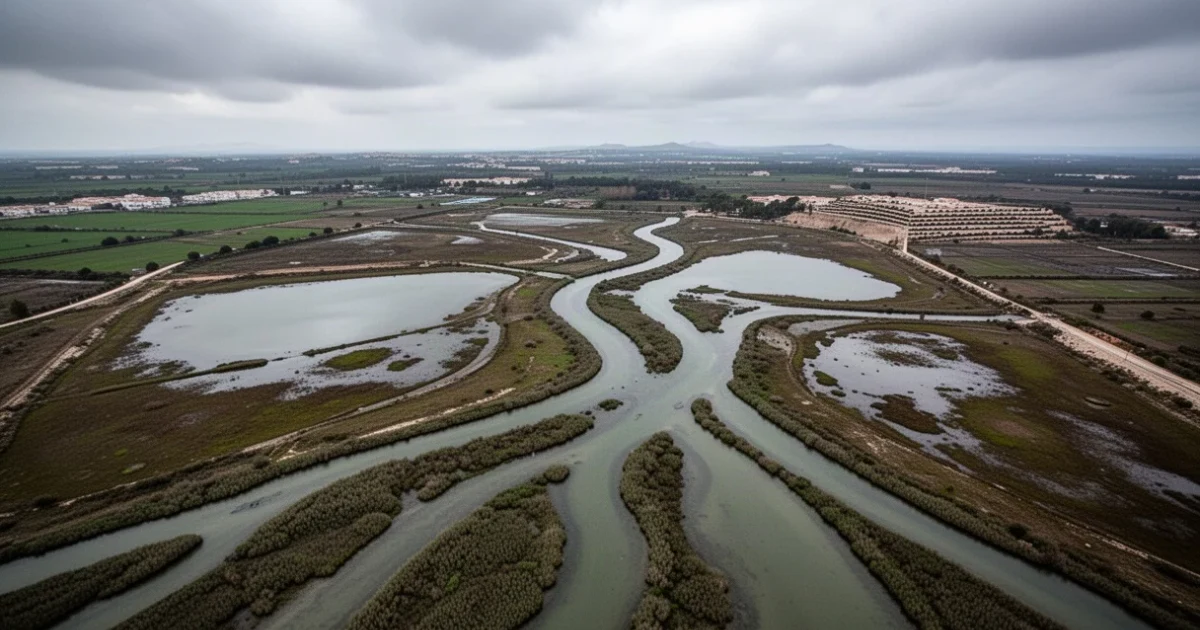

The long judicial conflict related to the saline waste mountain of Cogulló, located in Sallent (Barcelona), faces a new phase after the courts have confirmed the obligation to proceed with its dismantling.
The High Court of Justice of Catalonia (TSJC) has rejected the latest challenge presented by Iberpotash, now ICL Iberia, within a judicial procedure that has lasted for approximately two decades.
The ruling affects a massive accumulation of waste from mining activities that occupies around 45 hectares and contains approximately 45 million tonnes of saline waste.
The Origin of a Two-Decade Judicial Conflict
The conflict originates from complaints made by residents of Sallent regarding the accumulation of saline waste on land where urban classification did not allow such activity.
Although the first complaints related to the discharges date back to the late 1970s, the procedure that would eventually reach the courts began in 2006.
The residents' association from the Rampinya neighbourhood then requested the Sallent City Council to open a file aimed at restoring urban legality. They believed that the waste was being deposited on land where this activity was not permitted.
The residents, assisted by administrative lawyers, took the lack of municipal action to the contentious-administrative jurisdiction. From there, a judicial journey began that would lead to various rulings on the legality of the discharges and the obligation to restore the affected land.
In 2014, a ruling sided with the residents and established both the obligation to stop the discharges and the need to physically restore the affected land.
The ruling also included the dismantling of the accumulated saline waste outside the areas recognised by urban planning.
Subsequent Appeals Have Not Prevented Execution
Since that first ruling, various procedures and challenges have been filed with higher judicial instances.
One of the main points of conflict has been the effective execution of the judicial rulings. The residents demanded that the measures ordered by the courts be implemented given the persistence of the enormous dump.
In March 2024, the courts rejected the attempt to prevent the forced execution of a previous ruling that reiterated the obligation to act on the Cogulló deposit.
Subsequently, new challenges were presented. The Supreme Court rejected one of them, and the High Court of Justice of Catalonia has done the same with another one presented later.
The inadmission of the cassation appeal means that the route used to try to halt this phase of the judicial procedure has not succeeded.
An Artificial Mountain of About 45 Million Tonnes
The size of the deposit explains much of the complexity of the problem.
The artificial mountain of Cogulló occupies approximately 45 hectares and accumulates around 45 million tonnes of saline waste from decades of mining activity.
The various judicial rulings indicate that approximately between 39 and 40 million tonnes should be removed.
Of that amount, about 33.41 million tonnes would have been deposited before the ruling issued in 2014.
The discharges at Cogulló definitively ended in 2019, so the conflict now focuses not on stopping new waste contributions but primarily on determining how the restoration of the area should be executed.
Subsequent Planning Does Not Legalise Previous Discharges
One of the arguments raised during the procedure was related to the modifications subsequently introduced in the municipal urban planning.
The Sallent City Council and the company had argued that the new urban regulation should be taken into account when assessing the situation of the deposit.
However, the judicial rulings have considered that a subsequent modification of the planning cannot serve to legalise actions carried out previously on land where discharges were not permitted.
This aspect is particularly relevant because a large part of the waste was deposited on agricultural land, a use that was incompatible with the creation of the dump.
The Environmental Impact of Cogulló
In addition to the urban conflict, the mountain of waste has generated concern for years over its possible environmental effects.
The presence of such a large amount of salt can affect both surface and groundwater. Rainfall and seepage can transport some of these materials to nearby watercourses.
The issue has been particularly linked to the Llobregat and Cardener basins, where problems related to salinity have historically been detected.
The mining activity carried out in Sallent and Súria has already led to other judicial procedures. In 2014, a court in Manresa convicted three Iberpotash executives for water pollution related to the management of mining waste.
In addition to the criminal consequences for those responsible, obligations were established to recover the areas affected by pollution and reduce the high levels of salinity.
The Major Challenge Will Be Executing the Restoration
The conclusion of the main judicial avenues does not mean that the environmental and technical problem is automatically solved.
The main challenge now is to determine how the restoration of an extraordinarily large facility will be carried out.
Among the alternatives that have been proposed over the years are the gradual removal of the waste, its possible industrial use, or the waterproofing and environmental recovery of certain areas.
Some experiences developed in other mining dumps in the region have included sealing the deposit and subsequently covering it with vegetation. However, the dimensions of Cogulló make any intervention considerably more complex.
The removal of tens of millions of tonnes of waste would require a prolonged effort over time and significant logistical infrastructure.
The judicial ruling consolidates, in any case, the obligation to restore the affected space and puts an end to a fundamental part of a conflict that formally began in 2006 and has pitted residents, the mining company, and public administrations against each other for twenty years.

You may also like