
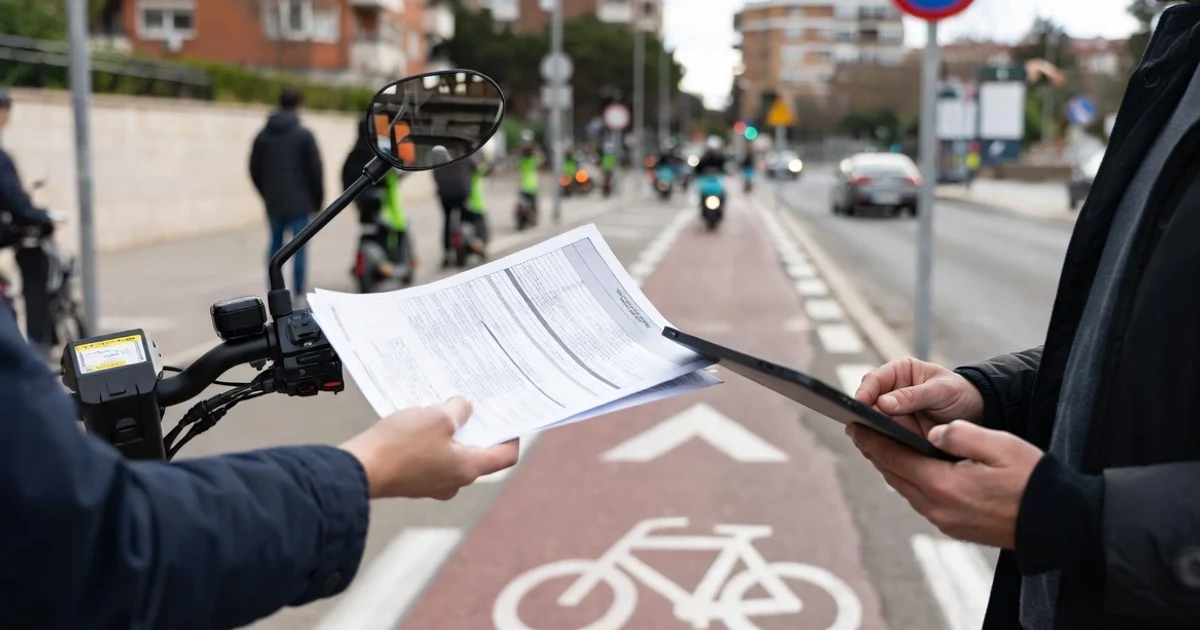
Living in a big city with crowded bike lanes and short distances between neighbourhoods has its advantages, but also its bureaucratic traps. One of them, which many people discover too late and in a bad way, is that their electric scooter needs paperwork. Yes, just like an appliance with the right to vote.
Why registration is mandatory
There’s no fine print here: any VMP (personal mobility vehicle) that reaches between 6 and 25 km/h must have an official identifying label and be registered accordingly. It’s not a friendly suggestion from the DGT, it’s a legal obligation with real consequences if you choose to ignore it.
The logic behind this makes sense if you think about it for two seconds: with the explosion of urban micromobility, the streets have filled with scooters that previously didn’t even exist as a legal category. They now share bike lanes with conventional bicycles, share space with pedestrians at crossings, and in many cases, reach speeds that a decade ago we only saw in mopeds. So, someone had to bring order.
And be careful, because riding without the label can lead to penalties comparable to those for a motorcycle or a car. We’re not talking about a symbolic fine for improper parking, but amounts that really hurt. So if your plan was to pretend it doesn’t concern you, it’s better to change your strategy.
What documentation is needed
The good part is that the paperwork, although it sounds intimidating, doesn’t require a master’s degree. To complete the registration, you will basically need:
- Technical sheet or certificate of characteristics of the scooter, usually provided by the manufacturer or seller.
- Owner’s details, that is, your details, with your ID or NIE at hand.
- Proof of purchase in case you are asked to verify the exact model.
With this, you practically have everything you need. The part that usually generates the most doubts is the technical sheet, especially if the scooter doesn’t come from a recognised brand or if you bought it second-hand with little documentation.
How to carry out the process
This is where many users get stuck thinking they will have to make an appointment, queue, and waste half a morning in an office. The registration of electric scooters with the DGT can be completed online without the need for a prior appointment, which, let’s be honest, is one of the few bureaucratic joys we have left.
The process involves providing the vehicle documentation, confirming your personal details, and waiting for the corresponding validation. Once approved, you will receive the identifying label that you must place visibly on the scooter. From that moment on, your VMP is officially recognised to ride smoothly on bike lanes and urban roads where permitted.
If you live in a busy area and use the scooter daily to move between neighbourhoods, this process stops being an administrative whim and becomes, directly, part of the basic maintenance of your vehicle. Like changing brake pads, but with paperwork.
What happens with non-factory certified scooters
This is the point where many get the least pleasant surprise. If your scooter does not have the factory certification required by regulations, registration becomes quite complicated. It’s not enough to fill out a form and cross your fingers.
In these cases, it is common for additional homologation to be required or, directly, for the model not to be registerable as it comes from the factory. This particularly affects scooters purchased through unofficial channels, imported without guarantees, or modified to reach speeds higher than allowed (yes, those that "go faster than normal" and that some boast about).
If this is your case, it’s best to consult the required technical characteristics directly before attempting registration, because otherwise you could end up with a very expensive scooter that legally cannot hit the streets.
Consequences of not completing the process
Letting the registration lapse is not simply "taking a little risk". The consequences are concrete and, frankly, not fun:
- Financial penalties that can be comparable to those for motor vehicles.
- Seizure of the scooter in case of police control.
- Additional problems in case of an accident, where the lack of registration can complicate any subsequent claim.
And here comes the part that almost no one takes into account: if your scooter is not registered and you suffer an accident, managing the claim becomes considerably more complicated. We’re not just talking about a one-off fine, but a problem that can follow you at the worst possible moment.
With the unstoppable rise of micromobility in large cities, these types of processes have stopped being an anecdote to become part of the daily life of anyone who uses the scooter as a regular means of transport. After all, between the bike lane, the morning rush, and the traffic light that never changes on time, the last thing you need is for the police to stop you for not having the label on.

Trending on the web

You may also like