Some factories invest in a new machine and, six months later, they are still hand-packaging half of their production because the equipment "doesn't adapt well." Spoiler: the machine almost never fails, the choice fails. And making the right choice is not a matter of luck, but of understanding what your product needs and what pace your plant must endure.
What is packaging machinery and why does it determine your profitability
Packaging machinery encompasses all the equipment that protects, groups, and prepares a product to reach the customer: from those that form, fill, and seal the packaging to those that stack boxes onto a pallet. It is not a decorative expense. It is the part of the production chain where margins are won or lost without anyone noticing.
A well-sized packaging machine reduces film waste, avoids unnecessary stops, and maintains a consistent sealing quality, something that the end customer appreciates even if they can't explain it. A poorly chosen one, on the other hand, gifts you micro-stops, damaged product, and an operator with a funeral face every Monday.
Horizontal packers: ideal for solid and regular products
When the product is unitary and has a defined shape (bars, biscuits, bakery products, medical materials, industrial parts), the horizontal format is usually king. This is where flowpack packaging solutions come in, which wrap the product in a pillow-type bag with longitudinal and transverse sealing at a speed that, compared to manual packaging, seems from another planet.
The real advantages worth considering:
- High speed with optimised film consumption.
- Cared-for presentation, highly valued in retail.
- Versatility of formats with relatively quick changes.
- Possibility to work with modified atmosphere to extend shelf life.
A tip that doesn’t appear in catalogues: before deciding, test with your actual product and your actual film. Technical data sheets are very nice, but your product is what matters.
Vertical packers: the option for bulk, powder, and liquids
If your focus is on loose products, the story changes. A vertical packer forms the bag from a roll, fills it by gravity with the help of a doser, and seals it. It is the usual solution for snacks, nuts, rice, legumes, coffee, detergents, frozen foods, and a long etcetera.
What weighs most in the decision is usually the dosing system, and each product has its own requirements:
- Multi-head for products that flow irregularly (snacks, frozen foods, confectionery).
- Auger for fine powders like flours or spices.
- Volumetric or piston dosers for liquids and creams.
Choosing the wrong doser is the quickest way to have bags with 5 grams extra in each unit. Multiply that by thousands of units a day and yes, you are giving away product.
Primary and secondary packaging: it's not the same
It is worth clarifying concepts, as they are constantly mixed up.
What each phase covers
- Primary packaging: the one that is in direct contact with the product (the bag, the pouch, the flowpack). Its mission is to conserve, protect, and present.
- Secondary packaging: groups several units into boxes, bales, or displays.
- Palletising: the final stage, where everything is organised onto a pallet for transport.
Why it's worth thinking as a whole
Designing the entire line from the beginning avoids the classic problem of buying a brilliant machine that then does not "communicate" with the next one. Integration between equipment is as important as each piece individually.
What questions to ask yourself before investing
Before requesting a quote from anyone, honestly answer these questions.
About the product and production
- What product are you packaging? Its fragility, moisture, size, and behaviour when dropped define almost everything.
- What speed do you really need? Not the one you dream of having in five years, but the current one with a reasonable margin for growth.
- How many formats do you handle? The more references, the more important the speed of change.
About the plant and service
- What space do you have? The plant of your dreams and the actual plant rarely match.
- What maintenance and technical service do they offer you? A stopped machine is money evaporating.
Complete lines: when the whole matters more than the piece
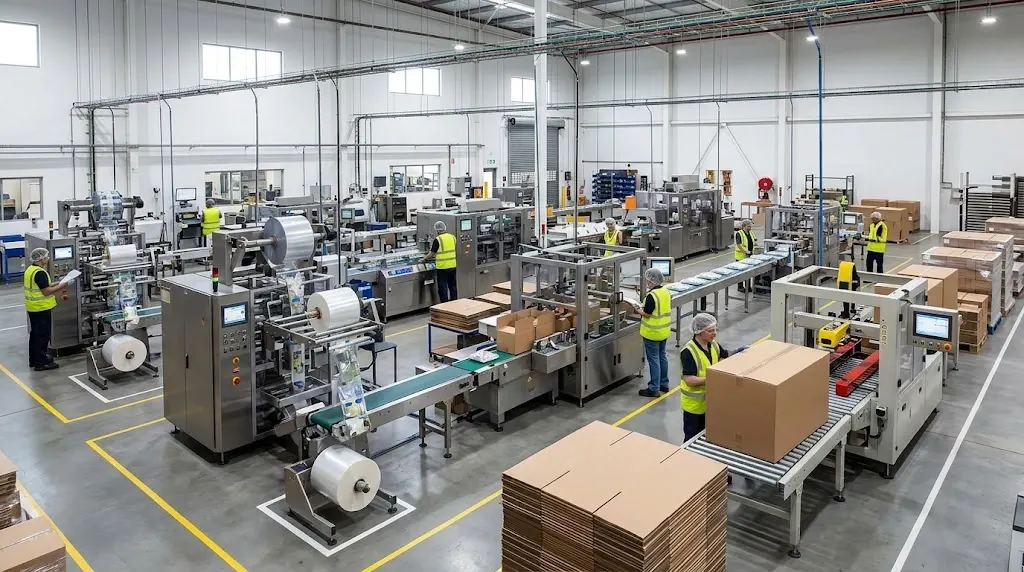
There comes a point where automating loose equipment no longer makes sense and it’s time to think about complete lines. Feeding, packaging, weight control, boxing, and palletising working in a coordinated manner reduce the dependence on labour for repetitive tasks and eliminate bottlenecks that previously went unnoticed.
The benefit is not just productive. A well-integrated line offers traceability, fewer human errors, and a safer working environment, something increasingly relevant with the regulatory demands of the food and industrial sectors.
Technical details that make a difference
What separates a good machine from an excellent one is usually not on the cover of the brochure:
- Stainless steel construction in contact areas, essential in food.
- Quick and accessible cleaning, because a machine that is difficult to clean ends up being cleaned poorly.
- Control with an intuitive touch screen and recipe memories to change formats without drama.
- Available spare parts and close assistance, the life insurance of any equipment.
If the company selling it also understands your sector and supports you in the start-up, you have half the battle won. A good machine with poor support is a bad machine, even if it doesn't seem like it on the first day.

Trending on the web

You may also like