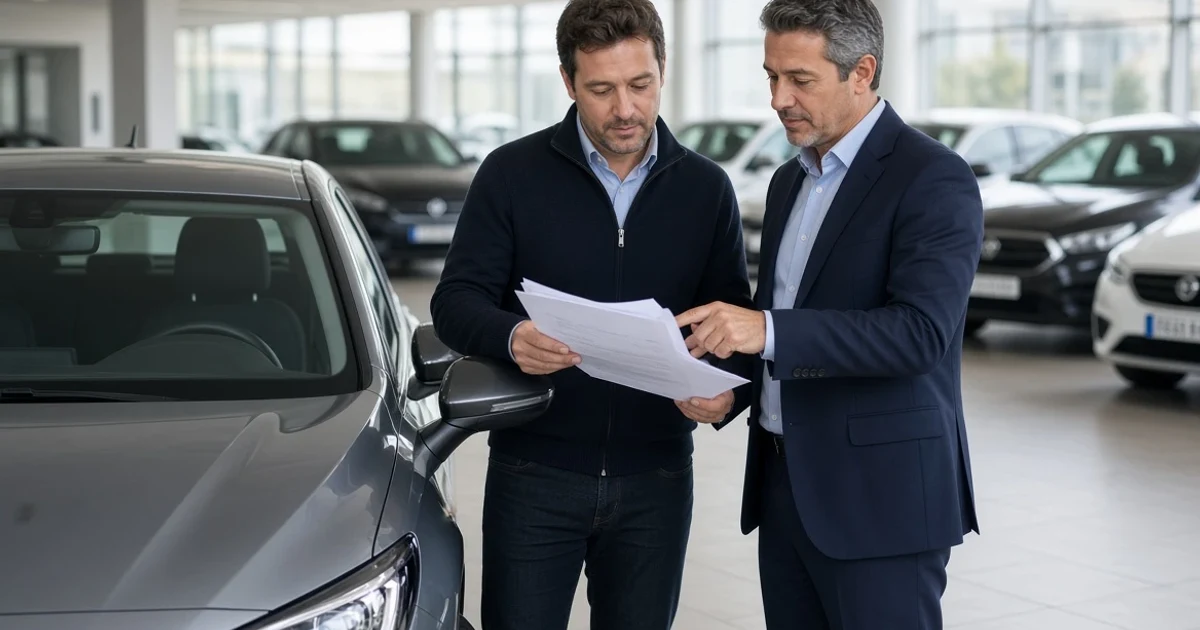

Those with a parking space don't know how lucky they are. The rest, the vast majority of drivers in Barcelona, leave their cars where they can: on the street, under a streetlight, next to a bin, or in that blue zone that becomes no man's land at night. And that, although it may not seem like it, comes at a price that is directly reflected in the insurance policy.
What happens to a car that sleeps on the street
A car parked on the public road is exposed to a list of incidents that those with a garage wouldn't even consider. Theft of mirrors, door handle pulls, scratches from another vehicle manoeuvring poorly, broken windows from a hit, or directly an attempted theft of the vehicle itself. None of these events is a tragedy on its own, but when added up over a year, they explain why insurers scrutinise where the car sleeps each night.
You don't need to live in a troubled neighbourhood to suffer any of these mishaps. Just parking in a narrow, poorly lit street or one with heavy traffic from large vehicles can significantly increase the likelihood of a hit without a note on the windscreen. And that's where the real problem begins: the culprit almost never appears.
How the neighbourhood influences the policy price
Insurance companies work with accident statistics by area, and the postcode where the vehicle spends the night weighs more than many drivers imagine. It's not whim or prejudice: it's pure mathematics applied to risk.
The postcode as a risk variable
If your area records more car thefts, more acts of vandalism, or more minor parking accidents, the premium increases to compensate for that risk. It doesn't matter if your car is immaculate and you've never had a claim in your entire life; the neighbourhood speaks for you when calculating the insurance price.
This explains situations that may seem unfair at first glance: two neighbours with the same car model and driver profile pay different premiums simply because one parks in a quiet street of a residential area and the other in a busier nightlife zone. It's not the driver that changes, it's the street where the car sleeps.
What coverages cover these incidents
This is where it's worth pausing for a moment and reviewing the policy instead of assuming that "everything is covered." Many basic third-party insurances leave out precisely the most common incidents in the city: theft, vandalism, and window breakage.
The recommended coverage block
For a car that spends the night on the public road, a third-party insurance with expanded coverage covers exactly the most frequent incidents in the city: theft, vandalism, and window breakage. It's not necessary to switch to a full comprehensive policy if the car is already a few years old, but it is advisable to ensure that these three coverages are explicitly included, as many basic policies simply do not list them.
Window breakage is, in fact, one of the most common claims in dense urban environments, and also one of the least checked before signing. A hit from a loose stone, any kind of debris, or directly an act of vandalism can render the window unusable, and without this coverage, the cost comes entirely out of the owner's pocket.
Before renewing or taking out a policy, it's always a good idea to calculate car insurance online and compare what coverages each option includes for the same price. Sometimes the difference between one policy and another isn't in the final amount, but in what it actually covers when the car appears with a mirror torn off on a Monday morning.
Vandalism, the great forgotten
Vandalism is often treated as an anecdote until it happens to you. Graffiti, intentional scratches, mirrors broken from a kick on a party Saturday. These are events that rarely involve another vehicle, so a basic third-party insurance does not cover them. Only an expanded coverage or a comprehensive policy covers this type of damage, and it's worth checking it explicitly in the specific conditions, not relying on the commercial summary.
What to do when the culprit doesn't appear
This is, probably, the most frustrating scenario for any urban driver: you arrive at the car, there’s an obvious dent in the bumper, and there’s no trace of who did it. No note, no witnesses, no camera that recorded it. Without an identified third party, your own basic third-party insurance does not cover the repair, because that type of policy responds to damages caused to others, not to those your own vehicle receives.
This is exactly where an expanded coverage comes into play. By including own damage resulting from vandalism or hits without identifying the responsible party, the driver does not depend on finding the culprit to repair the car. And in a city where finding the cause of a parking hit is practically an act of faith, that difference is noticeable in the bank account.
The most practical thing, especially if the car spends nights on the street regularly, is to review the current policy with these specific questions in mind: Does it cover total and partial theft? Does it include window breakage without a high deductible? Does it respond to vandalism even if there is no identified third party? If the answer to any is no, you are probably paying less than you think you are, because on the day of the claim, that difference comes out of your pocket, not the insurer's.

You may also like