
The fast pace of life, the cost of living, and daily stress are putting hundreds of relationships under pressure. However, data reflects a paradigm shift: couples no longer wait for everything to fall apart before seeking mediation.
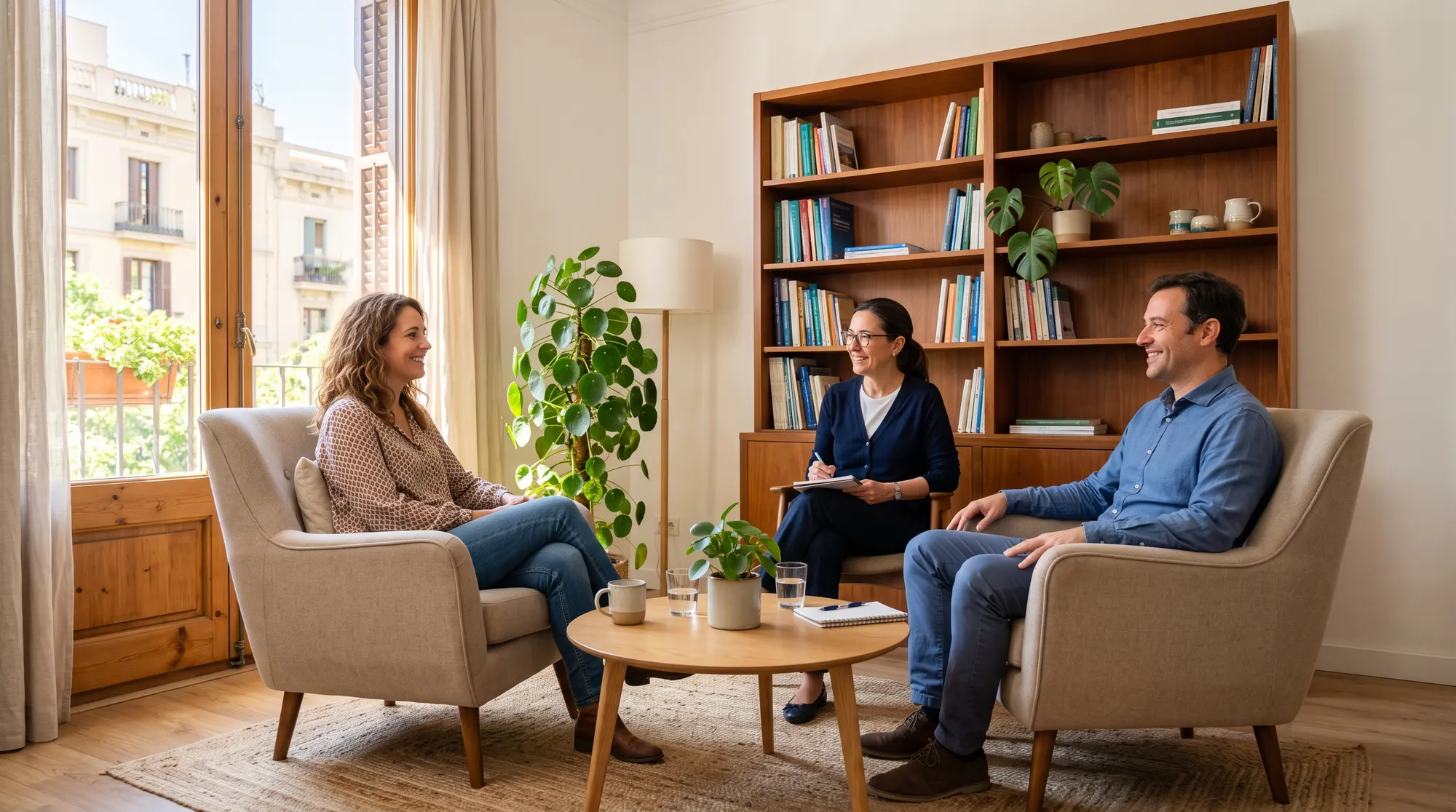
In the face of an impending deep crisis or lack of desire, the number of professionals offering therapy to heal couples' relationships in the Catalan capital has multiplied. Lola Sanmartín is a psychotherapist who offers couples therapy in Barcelona and Girona through her centre Enterapia. Couples therapy has established itself as the essential preliminary step before making drastic decisions. According to Sanmartín, going to therapy is not only to save a relationship: sometimes it is also necessary to close chapters, whether for consolidation or separation.
But when conflicts suffocate coexistence, the most pragmatic question arises: what is the real price of trying to save the bond?
The Map of Psychotherapy in the Catalan Capital and Its Prices
Currently, specialised platforms like MundoPsicólogos list more than 580 centres dedicated to this field in the city of Barcelona alone. Compared to the usual range in Spain (between €70 and €110), the average price of a session in the Catalan capital is between €80 and €130. Although the fee is slightly higher than that of individual therapy —due to requiring longer sessions, from 55 to 75 minutes— the approach remains highly structured. In more specialised clinical approaches, such as EMDR therapy or the systemic model, prices can range from €150 to €180.
According to the I Study of Social Impact on Emotional Wellbeing by Therapyside in 2022, couples therapy already accounted for 17.4% of all psychological demand in Spain, with women leading the search for help (68.9% compared to 31.1% of men). Appointments for couples therapy in Spain grew by 40% in 2025 compared to the previous year, according to internal data from the platform Doctoralia; a leap that coincides with the parallel increase in marital breakups and the growing normalisation of seeking professional help, especially among younger couples.
Couples Therapy vs Divorce: The Mathematics of Heartbreak
The fear of starting a therapeutic process is often accompanied by the false belief that it is a "costly and unguaranteed investment." However, the numbers debunk this myth. A complete therapeutic process —to assess, work through, and make conscious decisions— usually lasts between 6 and 12 sessions, which places the total investment of "trying to save the relationship" between €600 and €1,500.
When we compare this data with the cost of a formal separation in Catalonia, the contrast is stark. A mutual divorce incurs a minimum expense of between €1,200 and €1,800. If the process becomes contentious, or involves custody and asset division, the bill can easily soar to the range of €2,000 to €6,000. Strictly speaking from a financial perspective, trying to heal the relationship through clinical support costs half —or less— than breaking it, not to mention the high logistical costs and the emotional toll that a breakup entails.
Success Rates and the Importance of a Safe Environment for All
But does couples therapy work? The data indicates that it does. Various clinical studies, including a recent report from the Instituto Psicopartner (2023), place the success rate of couples therapy at around 77%, based on a sample of 256 treatments.
This figure is not an isolated case: it aligns with the consensus of professional organisations such as the American Association for Marriage and Family Therapy, which estimates that between 70% and 75% of couples report significant improvements in their relationship after completing the process.
These figures do not represent a guarantee, but they do signal that seeking professional help in a safe environment for both multiplies the chances of saving the relationship compared to doing nothing, explains Lola Sanmartín. Success —according to the therapist, who has treated hundreds of couples in therapy— depends as much on the method as on the genuine commitment of both parties.
Part of this success lies in the modernisation and specialisation of current psychotherapy. Far from imposing classic molds, today’s professionals address everything from lack of passion in long-established bonds to specific challenges of identity and visibility. Quality psychotherapy offers an integrative, affirming space free from heteronormative biases, where any type of couple —heterosexual or LGTBI+— can identify unhealthy fusion dynamics, regulate their emotions, and regain complicity without fear of being judged.

Trending on the web
You may also like