
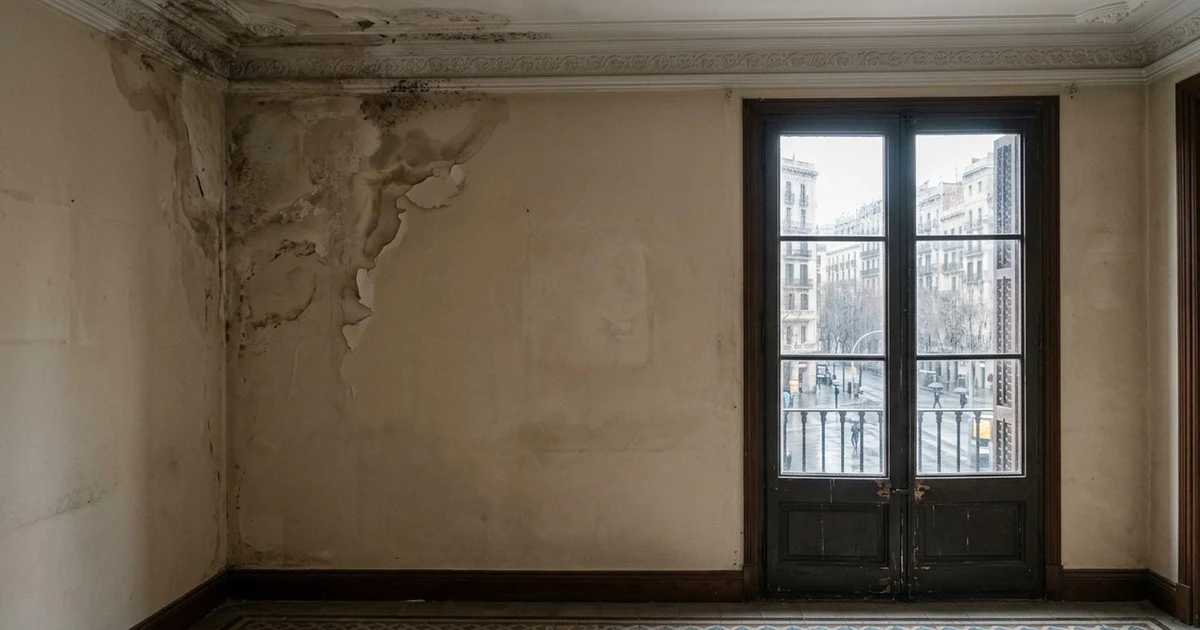
With an average of 91 mm, October sees more rain than any other month of the year in the city. It's not that humidity appears now: it's that now it becomes visible. Confusing a leak with condensation is the quickest way to pay twice for the same problem.
An Autumn That Reveals Everything
The normal climatological values from AEMET for the Barcelona-Fabra station, based on the 1981-2010 series, leave little room for interpretation: October averages 91 mm of precipitation, September 75, and November 66. Together, they account for 232 of the 621 mm that fall annually on the city. More than a third of the annual rainfall is concentrated in the quarter when, coincidentally, calls to professionals for stains on ceilings and walls spike.
The coincidence is not accidental. A roof with worn waterproofing can withstand a May shower but gives in after three consecutive weeks of rain. A ground floor wall that absorbs water from the subsoil has been doing so for months, but the stain only becomes visible when evaporation slows down as temperatures drop. October does not create the problem: it reveals it.
Three Types of Humidity That Look Alike but Are Treated Differently
Leak: Water Enters from Outside
It comes from a roof, a terrace, a façade, or a joint that has lost its watertightness. The stain appears or grows within hours or days after it rains, usually has defined edges and a darker border, and is located on ceilings, at the top of walls, or around windows and downpipes. If the flat is under a roof or adjacent to an interior patio, it is the first suspect.
Capillarity: Water Rises from Below
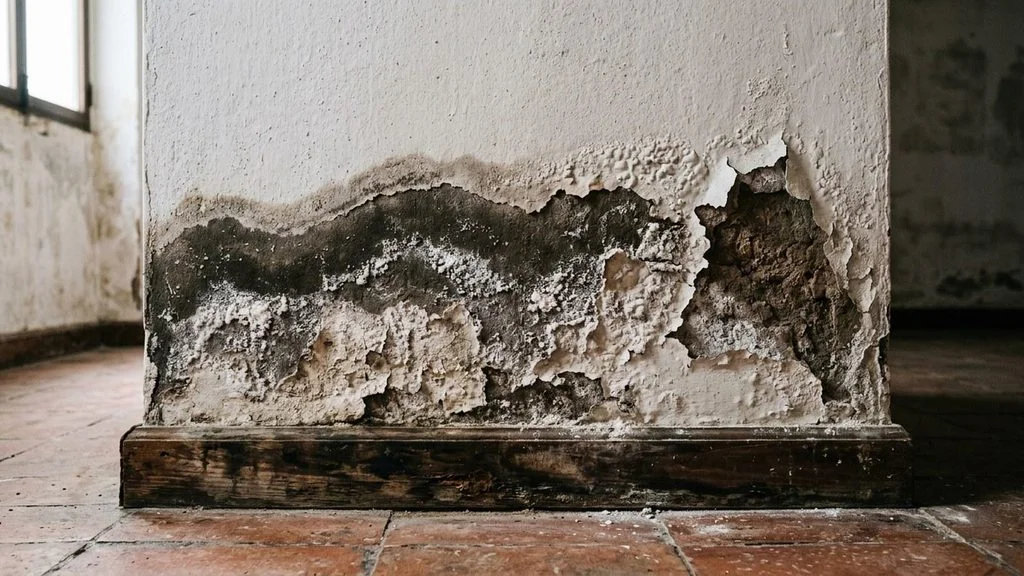
Water from the subsoil rises through the pores of the wall because it encounters no barrier to stop it. The stain starts at the skirting board and rises, rarely exceeding one and a half meters, has a wavy upper edge, and leaves efflorescences — that white powder of salts — and bulging paint. It is constant throughout the year and does not depend on recent rain. In Barcelona, it mainly affects ground floors and premises in buildings built before the 1950s, erected when moisture barriers were not standard practice.
Condensation: Water is Generated Inside
No water enters from anywhere: the steam produced by the dwelling itself condenses upon touching a cold surface. It appears in corners, behind furniture, around windows, and on walls facing north; the mould is black and superficial; it worsens in winter and improves with ventilation. It is the most common in renovated flats with airtight carpentry and no planned ventilation.
The Transparent Film Test
There is a home test that resolves the most common doubt — whether it is condensation or not — and it costs a piece of plastic and 48 hours of patience.
Stick a transparent film over the damp area, sealing all four sides well, and wait two days:
- If the droplets are on the outer side of the film, the humidity comes from the air in the room: it is condensation.
- If they are on the inner side, between the plastic and the wall, the water is coming from the wall: leak or capillarity.
This does not replace a diagnosis with a hygrometer, but it rules out or confirms the cheapest scenario to resolve before calling anyone.
Why Barcelona Accumulates So Many Cases
The built environment weighs heavily. The Technical Building Inspection is mandatory in Catalonia before a property reaches 45 years of age, according to the Decree 67/2015, of May 5, for the promotion of the duty of conservation. With that timeline, any building erected before 1981 should have its ITE in order today, and a good part of the Eixample, Gràcia, and Ciutat Vella is well above that age.
The ITE is not a decorative procedure: when it detects deficiencies in façades, roofs, or patios, it sets deadlines for repairs. Many damp issues that neighbours experience as their own problem are actually a pathology of the building, with costs shared among the community. Before assuming the bill, it is wise to know where the water is coming from.
Four Costly Mistakes
- Painting Over. An anti-humidity paint over a wall that continues to receive water hides the stain for a few months and returns the problem with peeling paint.
- Insulating Over a Damp Wall. Installing an insulating lining without resolving the source traps the moisture and accelerates deterioration.
- Requesting a Quote Before Diagnosis. A quote without identifying the type of humidity is a blind quote: the treatments and the cost of treating capillary moisture are nothing like those for a specific leak in a roof.
- Waiting Until Spring. Autumn and winter are the best seasons for diagnosis, precisely because the problem is active and visible.
When It Stops Being a Home Issue
If the stain reappears after painting, if there are salt efflorescences, if mould returns a few weeks after cleaning, or if the humidity affects common elements, the diagnosis stops being a home issue. It is advisable to request an assessment with moisture measurement and, when the source is in the building's envelope, to bring it to the community before acting independently. Specialized portals like Humedades.com maintain a list of verified humidity companies in Barcelona that can serve as a starting point for seeking a second technical opinion.
The October rain will not wait for the owner to decide. But a correct diagnosis in autumn almost always avoids a much larger job in spring.

You may also like



Muy interesante. Muchas gracias!