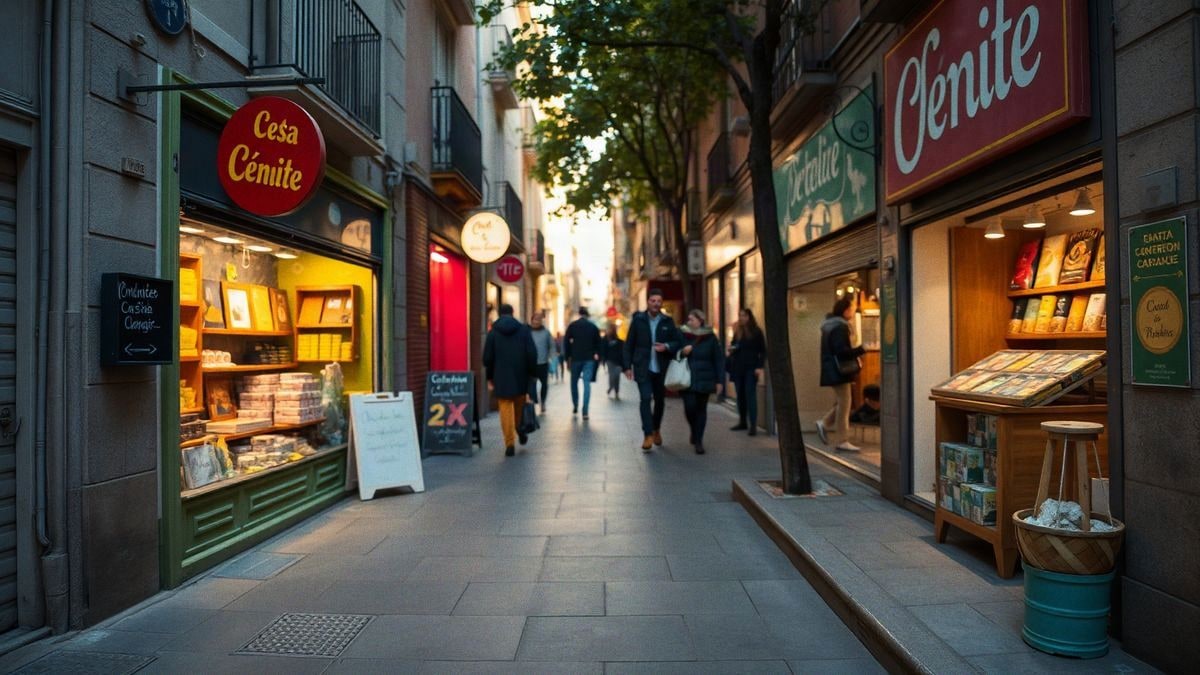
Barcelona has always had a very close relationship with small commerce. Just walking through neighbourhoods like Gràcia, Sant Antoni, or certain streets in Eixample reveals businesses that have built their identity around very specific products, ranging from food and design to cosmetics, fashion, or hard-to-find items in large chains.
What is changing is not necessarily that specialised character, but the way to reach the customer. More and more establishments are combining the physical store with an online shop, collection systems, and delivery services that allow purchases without giving up the proximity of a business located in the city itself.
The physical store no longer works alone
For years, having a suitable location could determine a large part of a commerce's success. A busy street, a neighbourhood with a compatible audience, and a recognisable storefront were fundamental elements to attract new customers.
All of that remains important, but the first contact with a store increasingly occurs through a screen.
Before approaching an establishment, many users search for the business on Google, check photographs, compare prices, read reviews, and review its catalogue. Sometimes the process ends with a visit to the store, and other times with an online purchase.
The boundary between physical and electronic commerce is, therefore, much less clear than it was a few years ago.
For Barcelona's specialised businesses, this transformation also opens the possibility of reaching people who might never walk past the establishment despite living in the same city.
Gràcia, Sant Antoni, and Eixample also have a digital storefront
The neighbourhoods continue to mark a large part of Barcelona's commercial personality.
Gràcia stands out for the presence of small establishments, independent projects, and specialised businesses. Sant Antoni maintains a strong relationship with local commerce around its market and adjacent streets. Eixample, on the other hand, mixes big brands with a huge variety of shops aimed at very specific audiences.
Internet does not eliminate those differences. In a way, it amplifies them.
A small shop can transfer part of that specialisation to its website through a more extensive catalogue than it could display in the storefront, explanatory content, and systems that allow checking in advance which products are available.
This is particularly useful in niche categories, where the buyer usually seeks something quite specific before heading out.
Specialised products find their space online
There are sectors where the specialised shop still holds particularly significant weight. This is the case with certain gourmet products, cosmetics, sports equipment, collectibles, specialty coffees, or hemp-derived products.
In these cases, the customer often needs more information than when purchasing an everyday item.
Someone looking for where to buy CBD in Barcelona, for example, can first check online the different available formats, the characteristics of each reference, its origin, or the information provided by the shop before deciding whether to place an online order or visit a physical establishment.
The same behaviour is repeated in many other specialised categories: first, research is done, and then a decision is made on how to buy.
Thus, simply having a website is no longer enough. The information it contains has become an extension of the advice that traditional local commerce offered.
Information becomes part of the service
When the catalogue is specialised, explaining the products well is fundamental.
An online listing should allow users to know the essential characteristics, the format, the quantity, the composition when relevant, and any important differences compared to other options in the same catalogue.
Photographs also play a practical role. They should not only serve to make a page attractive but also help the user understand what they are buying.
This becomes even more important in relatively new sectors or those that may generate doubts. Precise descriptions help separate the objective characteristics of a product from exaggerated promotional messages.
Specialised commerce has an opportunity here. In contrast to large platforms where hundreds of references appear practically without context, a business focused on a specific category can provide knowledge and facilitate comparison.
Buy online and pick up close to home
The hybrid model also allows recovering an advantage that seemed exclusive to electronic commerce: convenience.
Buying from a mobile and receiving the order at home is one possibility, but not the only one. Some consumers prefer to browse the catalogue at their leisure and then pick up their purchase personally. Others first check the website and then visit the establishment to resolve any last doubts.
Delivery services within the city itself are also gaining relevance, especially when the commerce deals with products that can be easily transported.
For a Barcelona business, this means that the physical store is no longer limited exclusively to people passing by on the street. Its area of influence can extend to other neighbourhoods without necessarily losing its local character.
Reviews are the new word of mouth
Small commerce has always relied significantly on recommendations. What used to happen among neighbours, friends, or family now also occurs on Google and other digital platforms.
Reviews allow someone who has never visited a store to get a first impression about the service, orders, delivery times, or the experiences of other customers.
They are not a perfect system, and an isolated rating should not determine a purchasing decision, but the overall opinions do influence the reputation of many local businesses.
Answering questions, keeping hours updated, and clearly explaining purchasing conditions are now part of the customer experience, even if all this happens before they walk through the door.
Local and digital are no longer opposing models
For a time, the growth of electronic commerce was presented as a direct threat to local shops. The current reality is much more complex.
A local establishment can sell online. A digital purchase can end up being picked up at a physical store. A user can discover a business on Google and later become a regular customer of the establishment.
In a city like Barcelona, where commerce is part of the identity of many neighbourhoods, this model offers a way to combine two advantages: the specialisation and proximity of small businesses with the convenience of digital channels.
The challenge is no longer just about deciding between opening a store or selling online. For many businesses, the question is how to make both experiences work together.

You may also like