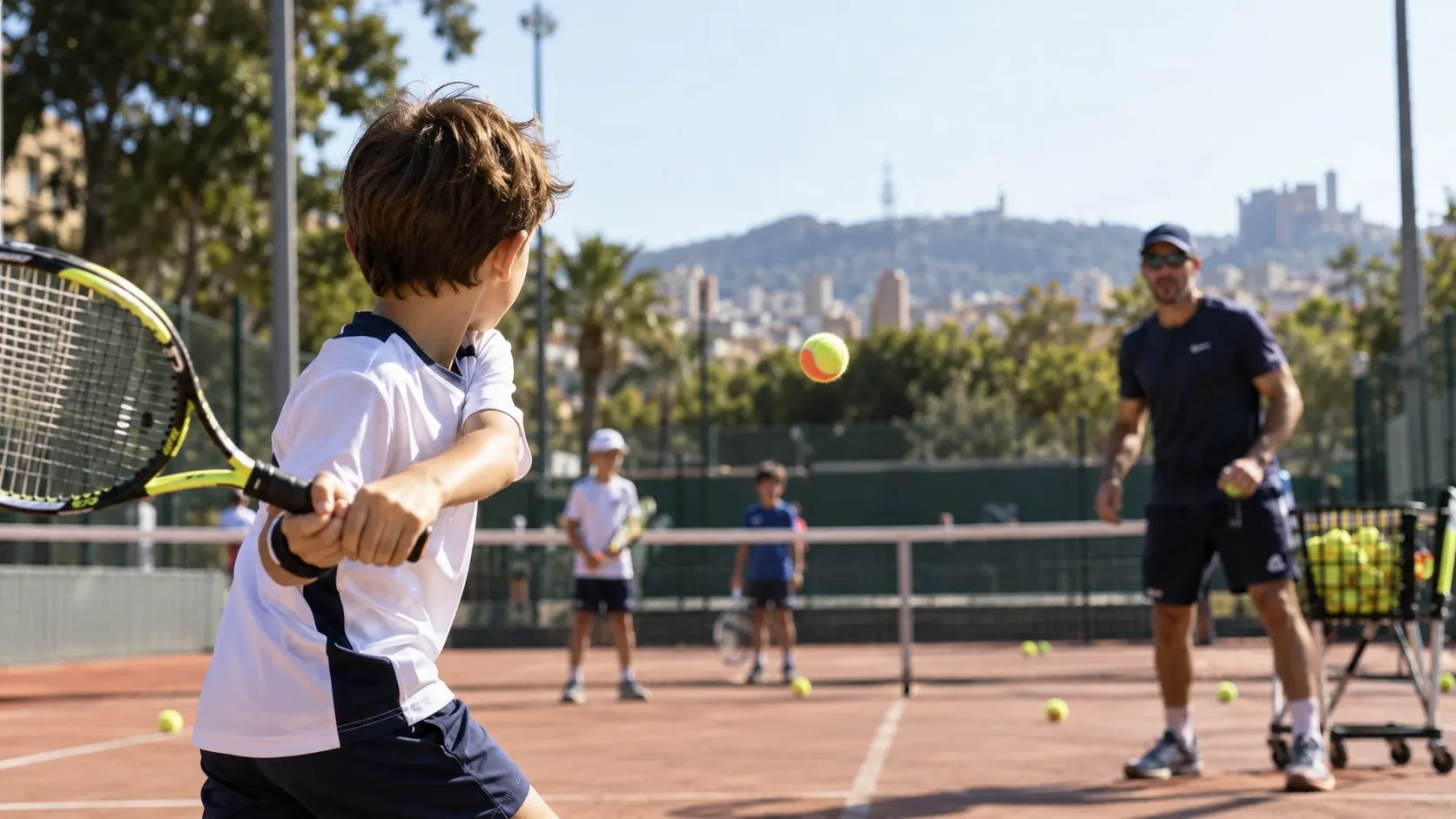
The tennis courts of Barcelona have new aspirants. More and more children are arriving at their first class with a racket under their arm and a name on their lips: Carlos Alcaraz. His example is awakening a new excitement for tennis among the youngest.
The 23-year-old Murcian tennis player has become the great reference for a generation. His influence is evident in families seeking tennis classes for children in Barcelona because their child wants to learn to play "like Alcaraz."
At a padel and tennis club in Barcelona like Vall Parc, this excitement is seen every afternoon in the children's school, where the youngest take their first swings with specialised coaches and in groups adapted to their age and level.
From Nadal to Alcaraz: The Idols Filling Tennis Schools
Great athletes have always had a contagious effect. This happened with Rafa Nadal, who for two decades filled schools with children imitating his topspin forehand. And Barcelona knows this well: the generation of Arantxa Sánchez Vicario, Sergi Bruguera, Àlex Corretja, or Albert Costa turned the city into a breeding ground for tennis players, with the Conde de Godó Trophy as a showcase every spring.
Today, Alcaraz is leading this transition. His appeal to children is easy to understand: he plays with a smile, takes risks, invents impossible shots, and celebrates every point with contagious energy. He conveys something that any child recognises immediately: that playing tennis is fun.
In 2026, he also added a story of overcoming challenges. A wrist injury sidelined him for four months, he returned at the US Open, and in October he regained his smile with the title in Tokyo, his first trophy after the injury. With the Paris Masters, the ATP Finals in Turin, and the Davis Cup on the November calendar, tennis is once again filling the screens of many homes. And what children see on television, they want to try on the court.
What Tennis Offers Children
Beyond the excitement of imitating their idol, tennis provides children with benefits that are noticeable both on and off the court:
- Coordination and agility. Hitting a moving ball requires calculating distances, reacting quickly, and moving the whole body at once.
- Concentration. Each point requires attention, reading the opponent's game, and making decisions in seconds.
- Frustration management. Children learn to lose a point and move on to play the next one.
- Autonomy and confidence. On the court, the child solves the problems of the match by themselves, which reinforces their self-assurance.
- Respect and sportsmanship. Greeting the opponent, accepting decisions, and acknowledging a good point are part of the game from the first class.
- Healthy habits. Tennis can be played for a lifetime, helping exercise become a habit rather than a phase.
Additionally, there is a social component. Tennis schools are a place where children make friends outside of school, an advantage that many families value as much as the sport itself.
At What Age Can a Child Start Playing Tennis?
There’s no need to wait. Many children start around 4 or 5 years old with mini tennis, which adapts the sport to their size: shorter rackets, smaller courts, and low-pressure balls that are slower and easier to control.
As they grow, the court, racket, and ball evolve with them until they reach conventional tennis. Thus, each stage presents a challenge suited to them, and the child feels they are progressing from day one.
In the early years, the important thing is the game. The best schools present classes as a fun challenge, with circuits, games, and small competitions, so that technique is learned without the child losing enthusiasm.
How to Choose a Good Tennis School
Before enrolling a child, it’s wise to consider some aspects that make a difference:
- Qualified coaches with experience in teaching children, who know how to adapt classes to each age.
- Small groups organised by age and level, so each child receives attention and progresses at their own pace.
- A playful approach in the early stages, without rushing to compete.
- Well-maintained courts and safe, comfortable facilities for children.
- Monitoring the progress of each student and maintaining open communication with families.
- Timings compatible with school and other family activities.
Clubs that offer additional services have an added advantage for families: while the little ones train, parents can take the opportunity to go to the gym or enjoy the pool. The tennis class becomes not just an activity for the child but a plan for the whole family.
Dream Big, Play for Enjoyment
Not all children who pick up a racket today inspired by Alcaraz will reach the elite, and that’s not necessary. The true success of the “Alcaraz Effect” lies elsewhere: in thousands of children discovering the joy of movement, self-improvement, and sharing the court with others.
Alcaraz himself is the best example of this idea. His cheerful and brave way of competing reminds us that sport is enjoyed before it is won. That is the lesson many parents want to convey: that the racket should be a source of fun, not pressure.
With the end of the season in full swing, the tennis courts of Barcelona have a generation eager to play ahead of them. And if there’s one thing Alcaraz teaches, it’s that enthusiasm is the best starting point.

Trending on the web
You may also like