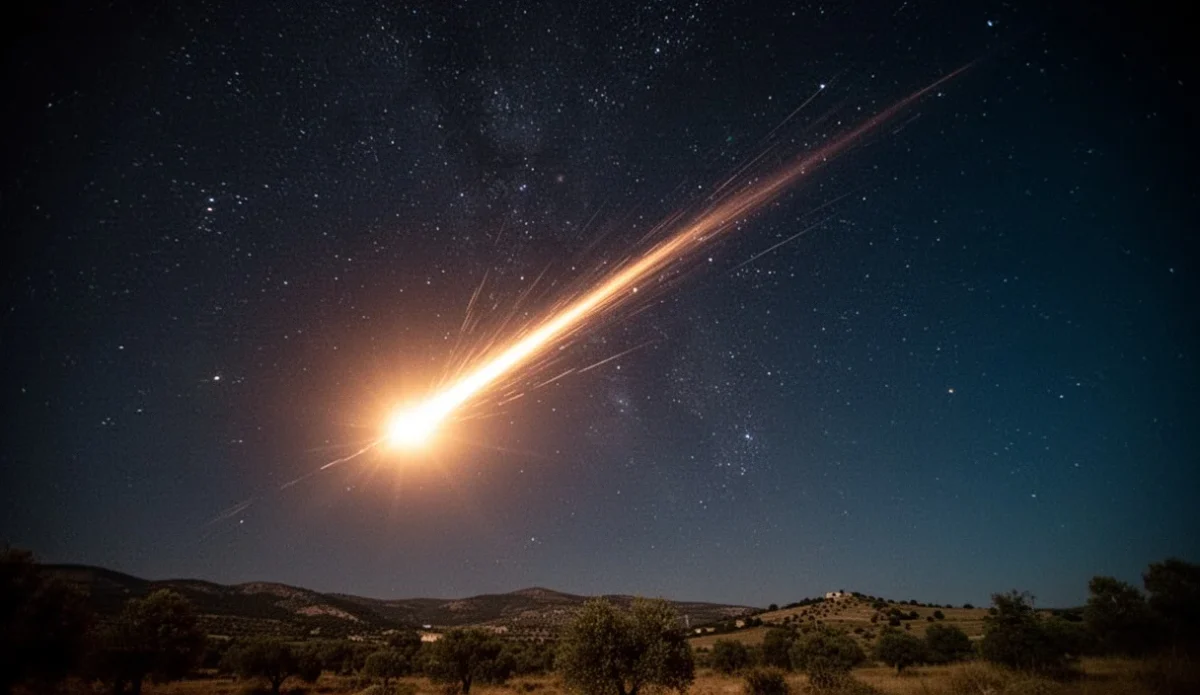
A brilliant superbólido illuminated the skies over Catalonia early Thursday morning, captivating residents and astronomers alike. The phenomenon was detected by multiple observation stations across the region.
In a dazzling display that captivated onlookers, a superbólido streaked across the night sky in Catalonia at approximately 2:30 AM on June 25. This extraordinary fireball was visible from various locations, marking a rare astronomical event that has drawn attention from both local residents and scientific communities.
The phenomenon was reported by sources from the Research Network of Bólidos and Meteorites (SPMN), which is coordinated by the Institut de Ciències de l’Espai. According to Josep M. Trigo i Rodríguez, a scientist with ICE-CSIC and member of the Institut d’Estudis Espacials de Catalunya, this type of bólido occurs when a rock enters Earth’s atmosphere at hypersonic speeds.
Trigo elaborated that while meteoroids are fragments resulting from asteroid collisions or planetary erosion, they become bólidos when they produce bright light as they interact with atmospheric components during their descent. The distinction lies in whether these objects survive to reach Earth’s surface; if they do, they are classified as meteorites.
The superbólido observed on June 25 was detected by around ten video detection stations throughout Catalonia and Valencia. Notable observation points included Pic Bartolo, operated by Vicent Ibàñez; Breda-Girona, managed by David Molner; and several others including Esparreguera and Gavà-Colomeres. Additionally, it was recorded by France’s FRIPON station in Marseille.
This particular bólido entered the atmosphere at an astonishing speed of approximately 140,000 kilometers per hour. Trigo noted that such luminous events occur only a few times each year in Spain, making this sighting particularly significant for both amateur stargazers and professional astronomers.
The Research Network of Bólidos and Meteorites has been active for over three decades, contributing to our understanding of these celestial phenomena. Historically, prior to their efforts, there had been a gap of 57 years without any meteorite recoveries in Spain.
This recent event not only highlights the beauty of our universe but also underscores the importance of citizen science initiatives like SPMN. As researchers continue to analyze data collected from various observation points, they aim to reconstruct the trajectory of this superbólido to determine potential landing sites for any surviving fragments.
Astronomy enthusiasts interested in following similar events can keep an eye on updates from local observatories or join community groups focused on meteor watching. Such opportunities provide insights into upcoming celestial occurrences and enhance public engagement with science.

You might also be interested in