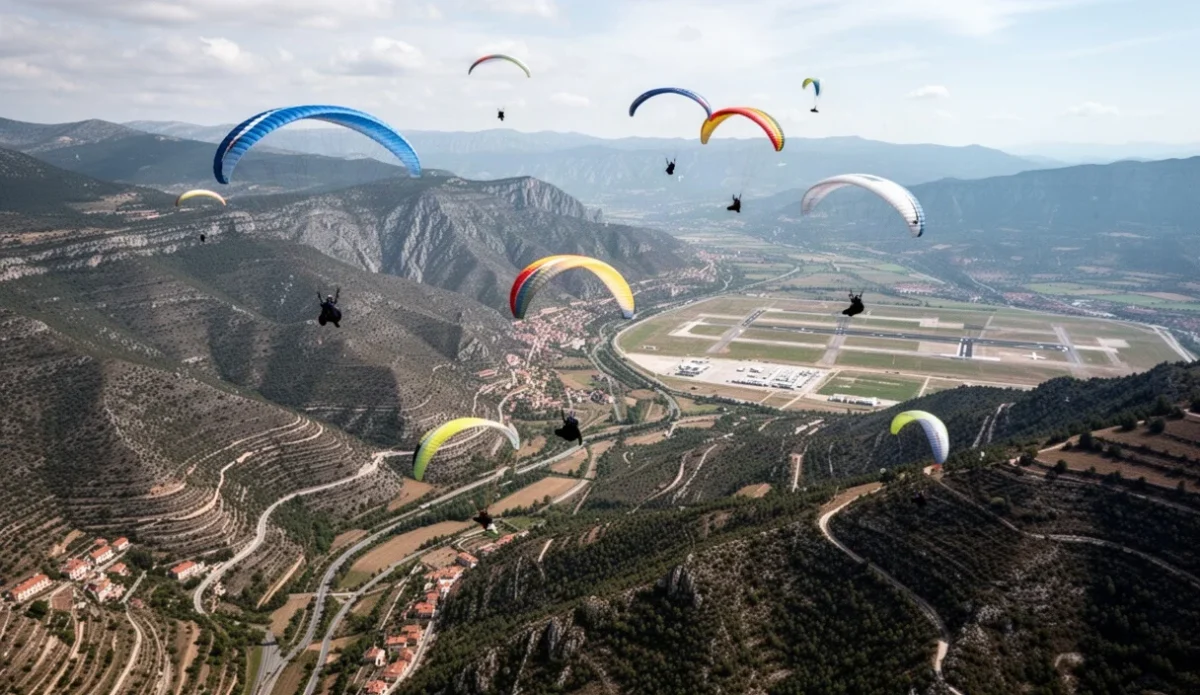
Aeroports de Catalunya has initiated trials of a groundbreaking system to improve safety for paragliders near Andorra-La Seu d'Urgell airport. This innovation could significantly reduce waiting times for both air traffic and paragliding activities.
Aeroports de Catalunya has launched a pioneering initiative in Organyà, Lleida, aimed at harmonizing the growing activity of paragliding with the operational demands of the Andorra-La Seu d’Urgell airport. The new system employs a real-time geolocation application designed to ensure safe coordination between paragliders and aircraft operating under instrument flight rules (IFR).
The introduction of this technology is crucial as it seeks to cut down the current waiting period for paragliders from an average of two and a half hours to just 15 to 30 minutes. This change comes in response to significant declines in paragliding activity over recent years, where many operators have reported losing more than half their business.
Paragliding has long been a staple recreational activity in Organyà, contributing substantially to the local economy by supporting hotels, restaurants, and flight schools. However, increasing air traffic at the nearby airport—recording 1,063 operations last July alone—has created challenges for planning flights safely. A third of these operations were attributed to public services such as emergency responders.
The innovative application is based on SafeSky technology that allows the airport’s control tower to detect connected paragliders’ locations in real time. Paragliders must install this app on their mobile devices, sharing their altitude and position with air traffic controllers. Additionally, an antenna has been set up at Organyà’s launch site to capture aerial traffic signals like ADS-B and relay them back to the platform’s servers.
Currently, when an aircraft is scheduled for takeoff or landing, all paragliding activities are halted until clearance is given. With the new system in place, Oscar Madrid, director of Andorra-La Seu d’Urgell airport explains that “there will be a window of between 15 and 30 minutes during which we can notify paraglider coordinators about upcoming flights.” This means that paraglider pilots will need to relocate either to designated safe zones or land temporarily until they receive clearance.
This protocol differentiates between visual flight rules (VFR) and IFR operations. Paraglider pilots can continue flying without restrictions under VFR conditions while maintaining an altitude below 6,000 feet, which provides a safety buffer since most visual flights operate at around 6,500 feet.
A coordinator will oversee activities at the launch site ensuring compliance with app usage among all pilots and establishing emergency protocols for any violations. The successful implementation of this system hinges on validation from Spain’s Agencia Estatal de Seguridad Aérea (AESA), which is expected after trial completion.
Aeroports de Catalunya plans to submit a technical report following these tests with hopes that AESA will approve deployment by early 2027. If validated, Catalonia would become a leader in integrating such technologies within Spain—a model potentially exportable to other airports worldwide.
The announcement has been met with enthusiasm from the paragliding community after enduring years of operational setbacks. Fernando Martínez from Parapent Barcelona acknowledges improvements but notes ongoing challenges: “We still have limitations; we must land one hour before any aircraft arrives or departs.” He emphasizes that while this new system alleviates some pressure on scheduling, continued growth in air traffic could negate these benefits if not managed properly.
The economic impact on local businesses has been severe; many operators have ceased taking new bookings due to unpredictable scheduling since March. As Martínez puts it succinctly: “Right now I’m surviving on what I have.” For those interested in experiencing paragliding in Organyà once this system is fully operational next year, it’s advisable to stay updated through local flight schools regarding availability and scheduling changes.

You might also be interested in